
Getting Douglas County Court Records
Douglas County Combined Court's Clerk of Court holds every state District Court and County Court file. Each online channel does one job. CoCourts carries many public ROAs. The official docket tool lists hearings, and the statewide form pulls filed records. City ordinance cases and city traffic tickets belong with the municipal clerk that handled them.
- Identify the court and case number, year, class, or party names.
- Use CoCourts if a public ROA is enough.
- Submit the statewide Record/Document Request Form for a filed paper or authenticated copy.
- Select Douglas as the record location and name the exact item requested.
- Wait for the fee assessment, then follow the clerk's payment directions.
You can also work through the public counter at 4000 Justice Way, Suite 2009, Castle Rock, CO 80109. Or email DouglasRecords@judicial.state.co.us. You can mail a request once the amount is confirmed, or use the phone contacts on the official courthouse listing. Fax won't work for filed documents. On-site inspection equipment exists at the clerk's discretion, so ask rather than assume. Attorneys and parties with Colorado Courts E-Filing access can pull documents from their own cases. Even so, CCE is not an anonymous Douglas County court record search. For administrative or aggregate data, skip the individual-case form. Write to courtdatarequests@judicial.state.co.us under CJD 05-01 section 4.40.
Douglas County Court Record Form
The form wants your contact details. It also wants a mailing address, plus the best case identifiers you have. A case number helps. It is not required. A party name, date of birth, filing year, case type, and Douglas location can route the request instead. Checkboxes separate family, criminal, civil, probate, ROA, and other documents. Certification is its own choice. The official record and document request form shows the full set of fields.
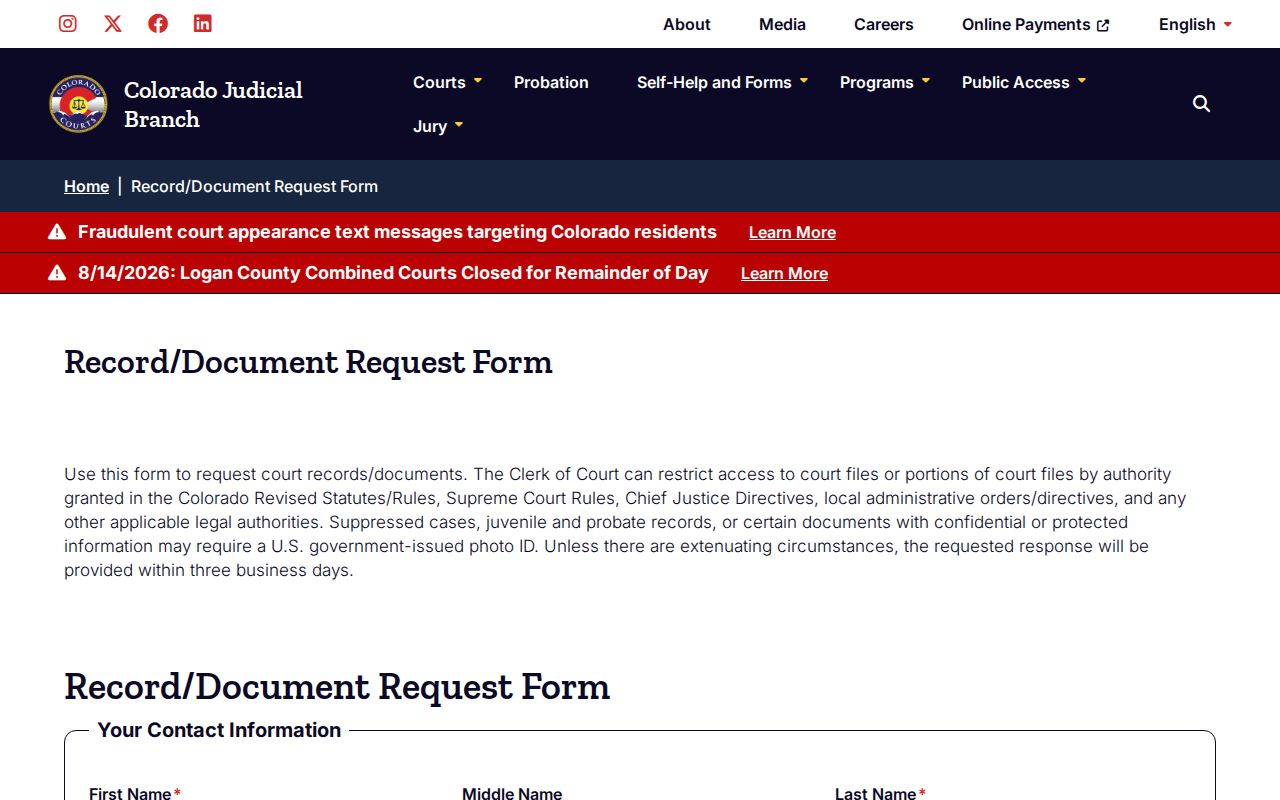
Those detailed fields cut the guesswork for the clerk. Name the exact order, decree, ticket, judgment, or ROA rather than requesting every paper in a thick file.
| Form field | Use | Helpful detail |
|---|---|---|
| Case number | Direct file match | Year, class, and sequence |
| Party information | Required identifying text | Names as filed |
| County/location | Routes the request | Select Douglas |
| Document checkboxes | Defines the product | ROA, order, decree, judgment, or ticket |
| Certified/exemplified | Adds authentication | Select only when formal proof is needed |
Court Record Types
One request can mean several products. The ROA is a short chronological index of the case. Plain copies reproduce accessible filed pleadings or orders. Certification or exemplification adds official authentication. A proceeding transcript records what was said in the courtroom. It moves through a separate workflow.
- Register of Action showing public case events
- Complaints, informations, petitions, motions, and tickets
- Minute orders, sentence orders, decrees, and judgments
- Transcript of judgment and certificate of satisfaction
- Certified or exemplified copies of accessible documents
Do not confuse a transcript of judgment with a hearing transcript. The first is a clerk product tied to a judgment. The second is word-for-word. For a proceeding transcript, email DouglasRecords@judicial.state.co.us. Or use existing CCE access when you have it. Then ask how the event was recorded.
Douglas County Court Record Layers
Keep three layers apart. CoCourts gives an unofficial real-time ROA. The clerk supplies an accessible filed document, and a certified or exemplified copy is the authenticated version of it. Paying a vendor never buys the underlying judgment.
| Product | What it contains | Custodian or channel |
|---|---|---|
| ROA | Dated case events and brief descriptions | CoCourts or clerk request |
| Filed document | Actual complaint, order, ticket, decree, or judgment | Originating court clerk |
| Certified copy | Filed paper with official authentication | Originating court clerk |
That split drives any Douglas County court record search. An entry can prove an order was docketed, but only the order itself shows the full text.
Inside a Douglas County Court Record
What sits inside a court record depends on case class and access status. Public material may show the court, case number, parties, filings, settings, orders, and disposition. Protected identifiers come out where required. An event can stay visible. Its filed item can still be closed to inspection.
| Case identity | Court, filing year, class, sequence, and public caption. |
|---|---|
| Party entries | Public names and roles allowed for release. |
| Filing history | Chronological ROA entries for submitted and court-issued items. |
| Settings | Public hearing dates, times, divisions, and setting types. |
| Outcome | Public disposition, sentence, judgment, or closing events. |
| Documents | Accessible pleadings and orders requested from the clerk. |
Redaction applies to sexual-assault victim identifiers, Social Security numbers, driver-license or personal-ID numbers, and financial account numbers where required.
Douglas County Court Record Response
The current web form promises a response within three business days absent extenuating circumstances. That target covers the response, not delivery of every file. Old files stored off-site add real retrieval cost. A broad request can trigger paid research or redaction work after the first hour. The current web form also controls over older printable language. That language cited three to five business days. Wait for payment instructions after the clerk assesses the request. Don't guess the total. Don't mail cash. Name the case, filing year, class, party, and exact document. The Douglas clerk can then tell an ROA from a complaint, order, decree, ticket, or certified copy. The official public-records access guide sorts vendor ROA access, individual court-file requests, and data requests into separate lanes.
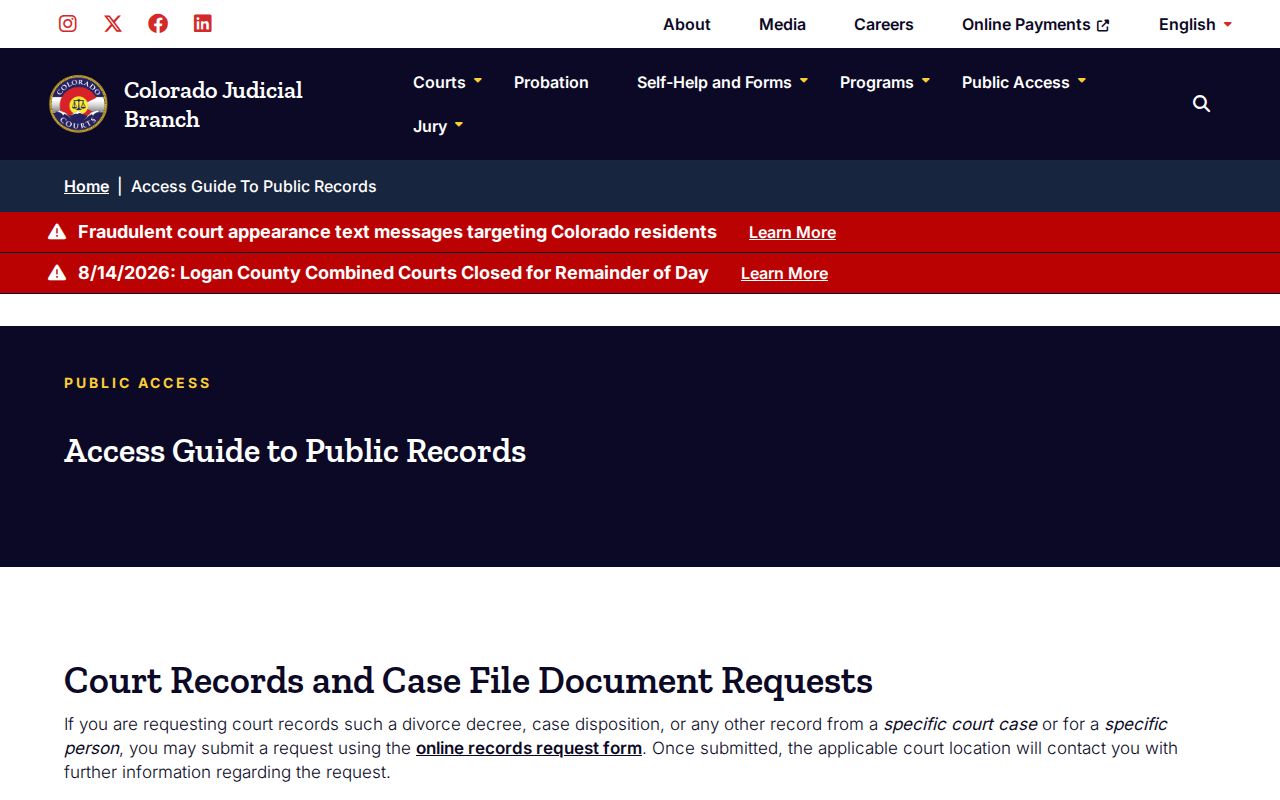
That channel map keeps a requester from sending a document request to the data office. It also explains why CoCourts will not hand you a PDF.
Fees and Certified Copies
Fees come from the official statewide request form. Confirm them when you order. The clerk assesses the request first, then sends payment instructions. A party or the party's attorney gets a stated copy cap. A nonparty does not.
| Item | Fee |
|---|---|
| Copy, per page | $0.25 |
| Party or party attorney maximum copy charge | $15.00 regardless of pages |
| Transcript of Judgment | $25.00 |
| Certificate of Satisfaction | $20.00 |
| Certified or exemplified copy, per document | $20.00 |
| Name search | $5.00 |
| Off-site retrieval | Actual cost |
| Research or redaction after first hour | $30.00 per hour in 15-minute increments |
Skip certification out of habit. A plain copy often answers an informational need, while formal filing or proof may call for authentication.
Douglas County Court Data Records
A single case file and court-wide data travel down separate roads. Dashboards and statistics belong to the Judicial Branch data channel under CJD 05-01 section 4.40. The Douglas individual-case form is not the right door. That material sits elsewhere. Administrative records of the Judiciary stand apart from filings in a litigated case as well. The Colorado Judicial data and reports page is the official source for these published datasets. The reports live there too.
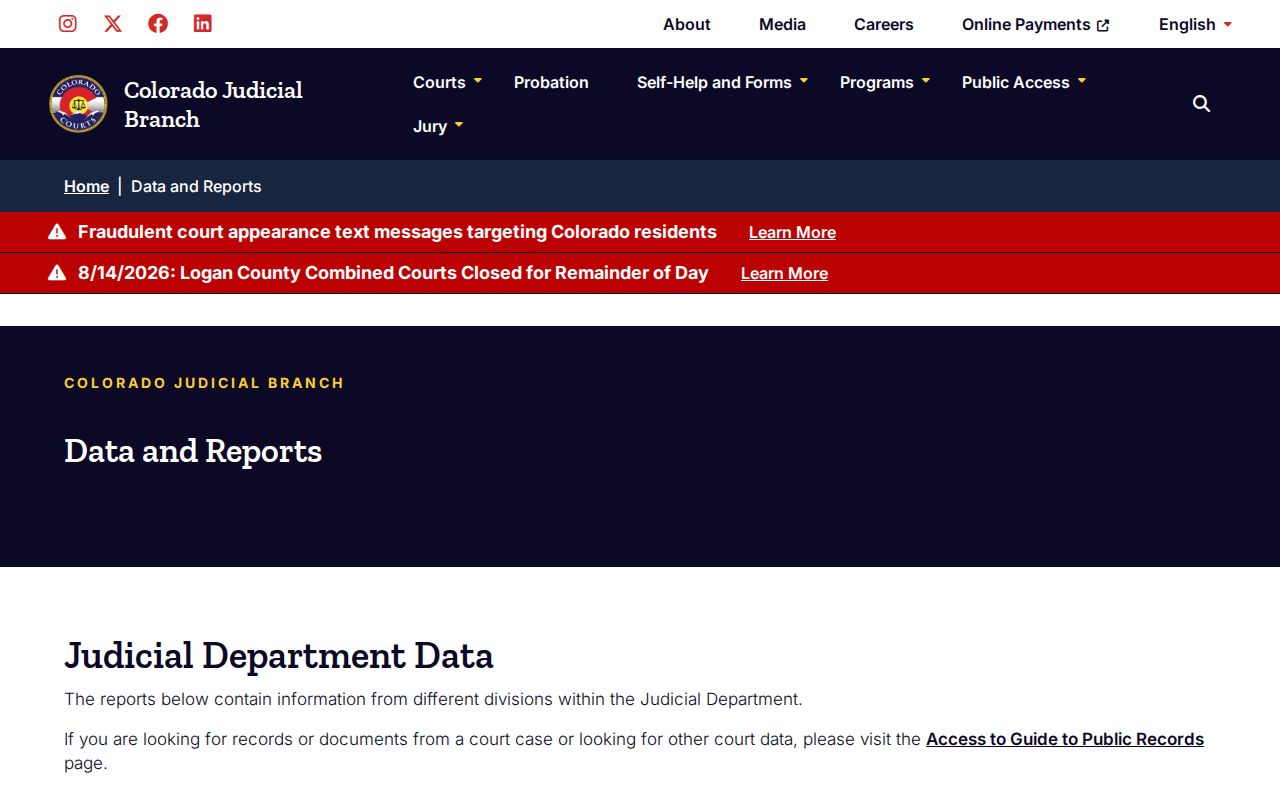
That source covers dashboards and statistical reports. For a complaint, order, or ROA in one Douglas County case, go to the Combined Court clerk instead.
Douglas County Off-Site Court Records
Older Douglas County files can trip people up. A paper file may bear the former 18th Judicial District name. It may also sit in off-site storage. The 2025 creation of the 23rd Judicial District changed that. Those older records stayed right where they were. To retrieve one, give the clerk the old caption, the filing year, the case class, and the sequence number. Expect retrieval billed at actual cost. The statewide form warns as much. Protected files add another layer. Suppressed, juvenile, probate, and similar records may require a U.S. government-issued photo ID before release. Never email sensitive ID unless the clerk directs you to a secure method. Exhibits can fall under retention or release orders, and dangerous, illegal, medical, psychological, or investigatory material is not automatically open.
Clerk of Court, Douglas County Combined Court
4000 Justice Way, Suite 2009
Castle Rock, CO 80109
Records: DouglasRecords@judicial.state.co.us
Public counter: Monday through Friday, 7:30 a.m. to 4:30 p.m., excluding state holidays
Sealed Records and Public Access
Chief Justice Directive 05-01 sets the framework for Colorado court-record access, working alongside more specific rules and statutes. That page is the official text of the directive.
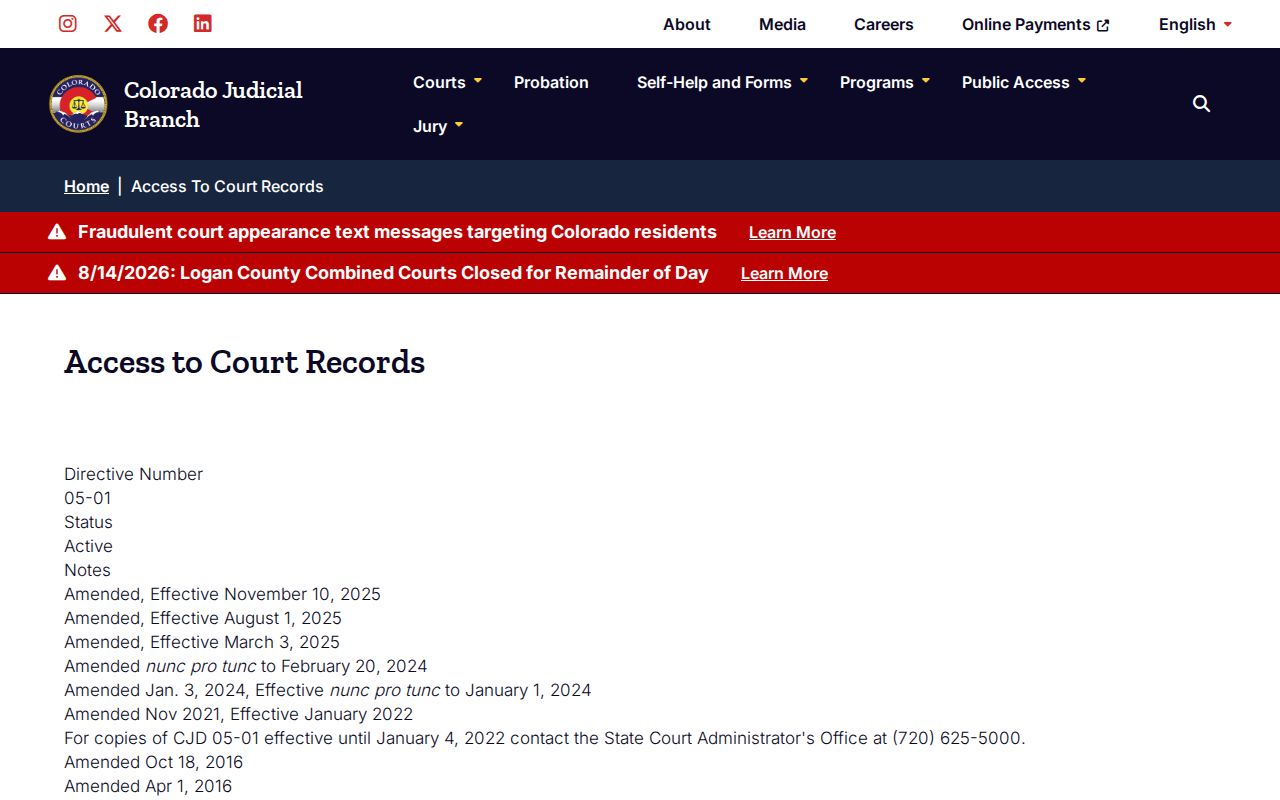
The directive lays out why access varies by case class, document type, and requester role.
Juvenile delinquency, dependency and neglect, adoption, mental-health, paternity, truancy, and judicial-bypass cases are among categories identified as nonpublic unless law or court order allows access.
Plenty of other material stays restricted too. Deposited wills, genetic testing, treatment records, juror questionnaires, presentence reports, probation files, custody investigations, medical material, and certain exhibits all face limits. Dangerous or illegal exhibits and child-abuse investigatory material are never automatically inspectable. Before releasing anything, the clerk must redact covered Social Security numbers, financial account numbers, personal identification numbers, and protected victim information. That happens when the governing rule requires it. Seeing an event on a public ROA does not override these rules. Sometimes access is lawful. The public tool may still be incomplete. The clerk can then walk you through the request process without deciding private legal rights. A related Douglas County case lookup may supply the case number a focused request needs.