
Searching Douglas County Criminal Dockets
Look first at the paper. The summons, complaint, notice, or bond sheet names the court you need. A felony docketed with CR belongs to Douglas County District Court. A misdemeanor marked M belongs to Douglas County Court. So does a state traffic matter marked T. A city-code charge or municipal traffic citation may instead stay with Castle Rock, Parker, Lone Tree, Castle Pines, or Larkspur. Both state courts share one office. That office is the Clerk of Court at the Douglas County Combined Court.
Two search tools cover these dockets. The Colorado Courts Record Search at CoCourts offers paid name and case-number searches across many felony, misdemeanor, and traffic Registers of Action. The Judicial Branch links it. Still, it is a vendor service, not the official court file. For a hearing date, try the free Judicial Branch Docket Search first. Just remember it is a calendar, not a complete criminal history.
- Confirm the filing court and case class from court papers.
- Use the free docket tool for a setting, or CoCourts for an available ROA.
- Search with the full year, class, and sequence when the case number is known.
- Read the newest non-vacated setting and each charge separately.
- Ask the Combined Court clerk for the actual order or charging document when its text matters.
Douglas County Criminal Docket Codes
Class letters come first in any Douglas County criminal docket search. They tell you what kind of state case you are looking at. They also show which court level holds it. That is all they tell you. Nothing in the letters hints at guilt. Nor do they show a final result or how serious a charge is. A case that moves to another court or gets appealed may carry a second number. Write both down. Match them to the transfer entries.
| Class | Court | Typical docket |
|---|---|---|
| CR | Douglas County District Court | Felony criminal case |
| M | Douglas County Court | Misdemeanor criminal case |
| T | Douglas County Court | State traffic case |
| City citation | Issuing municipal court | Municipal code or city traffic matter |
The split matters. Neither the state calendar nor CoCourts takes the place of a municipal clerk's docket. When routing is unclear, the ticket itself usually answers the question. Check the issuing agency. Check the court line printed on the ticket.
Inside a Douglas County Criminal Docket
Picture the Register of Action as a dated index. It tracks everything that has happened in a case. The header gives you the court, case number, class, filing date, and status. It also lists the roles of each participant. From there the entries pile up detail: charges, counsel, warrants or summonses, service returns, bond terms, settings, pleas, findings, dismissal or conviction, sentence, review, financial obligations, and any notice of appeal. One caution. A short event label is only a label. It never holds the full pleading or the order behind it.
| Case identity | Year, class letters, sequence, filing court, date, and status. |
|---|---|
| Charge | Alleged offense and statute or classification when public. |
| Bond | Amount, type, conditions, and later changes when entered. |
| Setting | Arraignment, pretrial, motion, trial, sentencing, or review date. |
| Outcome | Plea, finding, dismissal, conviction, disposition, and sentence entries. |
Read each charge on a Douglas County criminal docket on its own terms. One count can be dismissed while the rest move forward, so never treat the case as a single block. Money shows up here too, but a balance by itself proves nothing about how a charge ended.
Douglas County Criminal Docket Outcomes
A complaint or information shows an allegation the court accepted for filing. That is all it shows. A bond entry, likewise, only sets release or security terms. Neither one is a disposition. To learn the outcome, follow the Douglas County criminal docket forward until a plea, finding, dismissal, conviction, deferred disposition where applicable, or sentence appears.
Short ROA labels can leave real doubt. Ask for the document itself. The statewide Record/Document Request Form lets you pick the Complaint/Information or the Disposition/Sentence Order, choose Douglas as the location, and name the exact case. The clerk supplies the official filing. CoCourts, by contrast, cannot download the filed document for you.
Process: Complaint or Information › Advisement › Bond Order › Arraignment › Pretrial and Motions › Plea or Trial › Disposition › Sentence › Review or Appeal.
How a Criminal Case Moves
No Douglas County criminal case hits every stage. At a first appearance, the judge often handles advisement and release. Arraignment comes next, covering the charges and a plea. Later settings, such as pretrial, status, and motion hearings, record preparation or a request for a ruling. A plea hearing or trial may settle the merits, with disposition and sentencing entries after that. Even post-sentence, Douglas County review can continue.
Read the settings in date order. A continued or reset entry simply moves a hearing to a new day. A vacated setting drops that event but does not end the charge by itself. Check the latest criminal ROA entry against the official calendar and the newest signed notice. Douglas also holds Saturday bond hearings at 2 p.m. That setting is easy to mistake for the later arraignment or pretrial date. Keep them straight.
Douglas County Criminal Dockets on CoCourts
CoCourts searches available Douglas County criminal ROAs. Search by name or by case number. Pick Douglas as the county so namesakes elsewhere in Colorado drop out. Watch spelling and party role, since both affect matches. A full number works best, with its four-digit year, class letters, and sequence. An account or payment is required, and the vendor shows the current charge.
The vendor calls its data real-time. Even so, the result is unofficial. It may omit Douglas County cases or case types, and it can contain errors. Filed documents are not part of the download. Anything questionable belongs back with the court that made the record. For a simpler statewide walkthrough, see the Douglas County Case Lookup reference.
Note: A blank result may mean the wrong court. It may also mean a name mismatch, an uncovered case type, or a lawful access restriction.
Courts That Hold Criminal Dockets
Douglas County splits its state criminal work between two benches. Felonies sit in Douglas County District Court, while County Court handles misdemeanors and state traffic cases. Behind both sits one unified clerk, the Combined Court office at 4000 Justice Way in Castle Rock. So there is no district clerk and county clerk split here. The class of case changes, but the state filing desk stays the same.
Municipal courts add a second layer. Castle Rock, Parker, Lone Tree, Castle Pines, and Larkspur each run their own local ordinance and municipal traffic operations. A city ticket filed in one of those towns never turns into a state criminal docket just because the town sits inside Douglas County. A blank state docket search is not the end. Figure out who issued the charge, then call that municipal court before concluding nothing exists.
Douglas County Criminal Docket Orders
The Clerk of Court at Douglas County Combined Court keeps the official criminal file. Requesters have several routes. Use the statewide form, or email DouglasRecords@judicial.state.co.us. Ask the clerk to inspect an available record, or simply visit the counter. Current contact details sit on the official Douglas court page. Files stored off-site may involve a retrieval charge at actual cost. Municipal records must go to the issuing municipal clerk instead.
Give the clerk enough to find the docket. That means the year, the class, and the sequence. Name the document you want. It may be the Complaint/Information, the Register of Action, or a Disposition/Sentence Order. Certification is worth asking for only when you need an authenticated copy. The Judicial Branch access guide draws the line between a case-record request and an administrative-record or compiled-data request.
Sealed Dockets and Public Access
Colorado Rule of Criminal Procedure 55.1 starts from openness. Criminal court records are presumed public. A statute, rule, directive, or court order must say otherwise. Chief Justice Directive 05-01 fills in the practical rules, covering remote and facility access, excluded records, fees, vendor duties, and corrections. Even so, juvenile, sealed, expunged, and individually restricted records may be missing from view or only partly visible on a Douglas County docket search.
Douglas criminal docket access: Rule 55.1 governs access to criminal court records. Chief Justice Directive 05-01 governs public court-record access. Colorado's Criminal Justice Records Act, C.R.S. sections 24-72-301 and following, also addresses criminal justice records.
One narrow tool exists for sealed cases. The automatic-sealing confirmation search serves one purpose: letting a defendant check a single case under C.R.S. section 13-3-117. It will not confirm every kind of seal. Expect to prove identity, and know that the clerk can disclose nothing when the law blocks release.
Missing Douglas County Criminal Docket Results
Start with the right court. A felony belongs in Douglas County District Court. A misdemeanor usually belongs in County Court. A city citation belongs with its municipal clerk. Then test your search terms. Check the exact spelling, the year, the class, and the sequence, and if the case moved or was appealed, keep both case numbers handy. Compare three sources next: the free hearing calendar, the paid ROA search, and the court papers already in your possession.
The Colorado sealed-case page explains why an empty Douglas County public result deserves a second look.
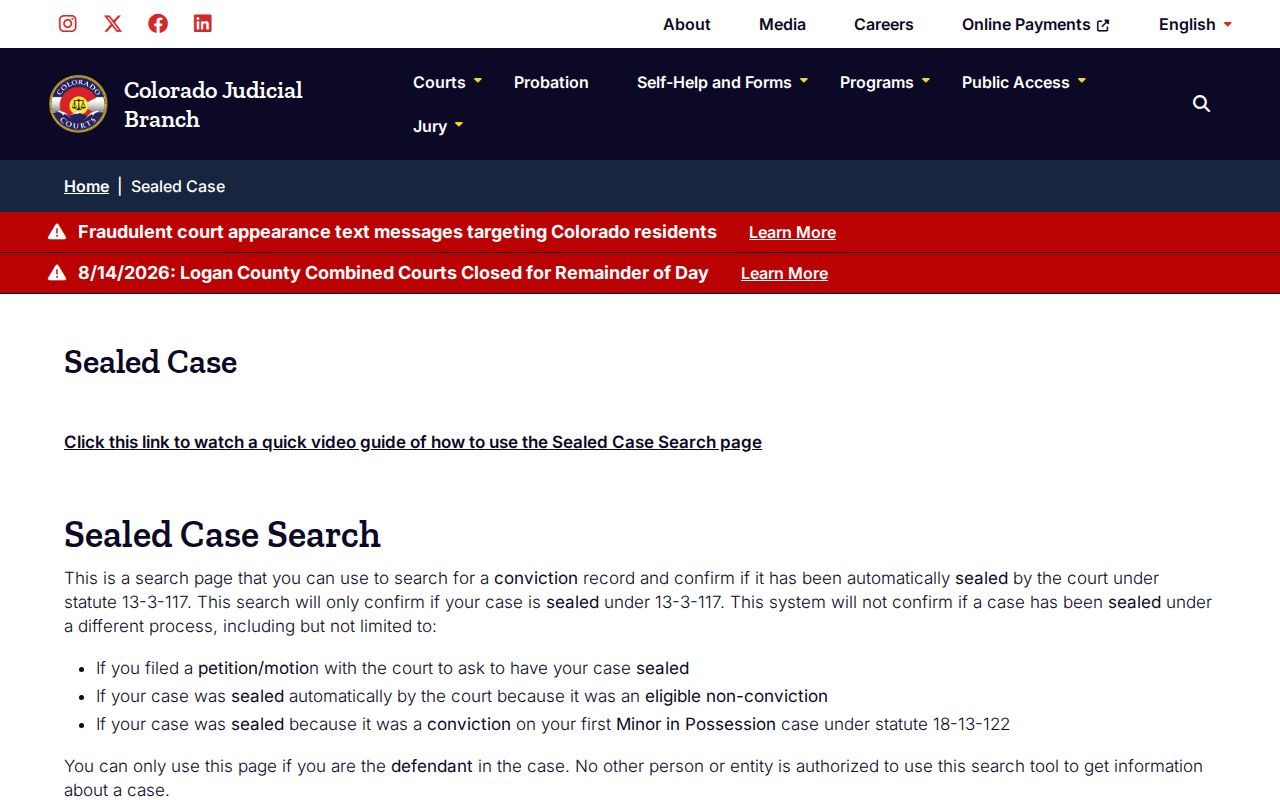
That confirmation route is only for the defendant. The bigger lesson matters more. No public search result proves that no case exists. For a state matter, contact the Douglas Combined Court clerk; for a city matter, contact the proper municipal clerk.